Dubai Property Market Sales Overview - Monday, 15 June 2026
Total Sales Value and Volume
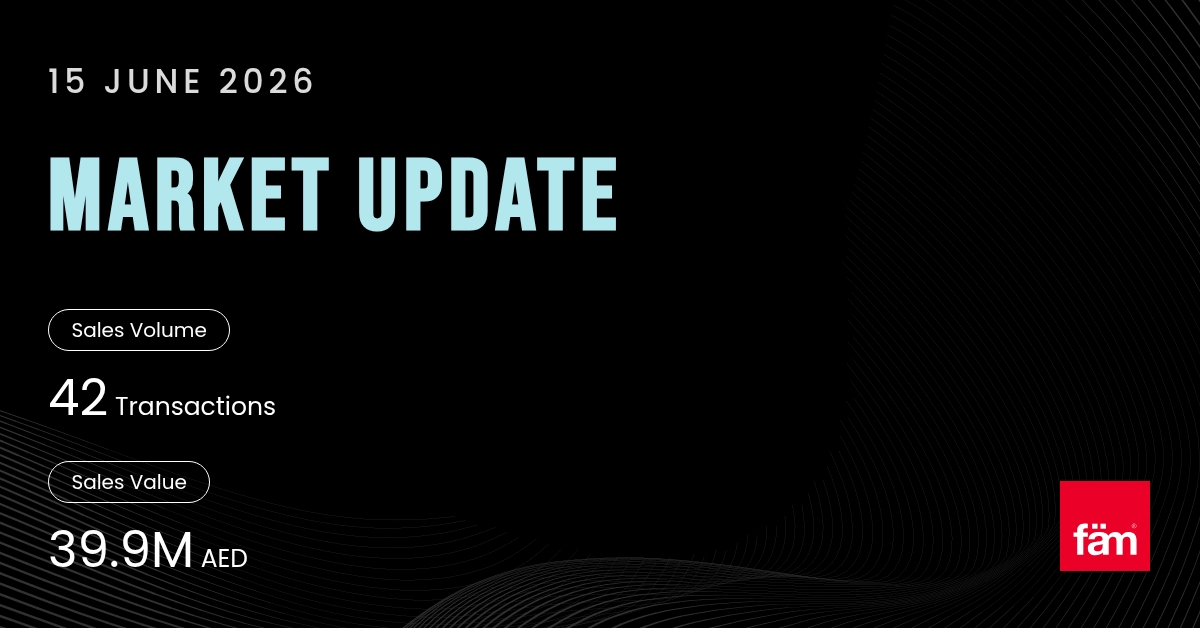
On Monday, 15 June 2026, the Dubai property market maintained a steady pace with a total of
42 transactions recorded throughout the day. These sales collectively amounted
to an impressive 39.9 million AED in transactional value. This volume denotes a
moderate yet significant level of market activity, reaffirming Dubai's position as a thriving real
estate hub in the region.
The transaction count, while not exceptionally high, reflects a balanced interest from investors
and end-users alike. This suggests that the market is currently experiencing a steady demand phase,
potentially driven by both primary buyers looking for new developments and resale market participants
capitalizing on attractive pricing or location advantages. The nearly 40 million AED turnover also
points toward a strong appetite for mid to high-tier properties, predominantly in the residential sector.
The Most Prominent Transactions
Diving deeper into the market activity, we observe that several projects emerged as focal points for
buyer interest. Notably, primary market apartments led the charge, with Azizi Jewel setting
the pace with 12 units sold and an aggregate sales volume of 7.4 million AED.
This level of activity highlights Azizi Jewel’s allure as a contemporary residential development offering
modern lifestyle benefits, appealing to investors seeking quality and liquidity.
Following closely are developments like Enchante By Grid - RT2 and Azizi Venice 8 -B,
which accounted for 6 and 5 units sold respectively, with their sales volumes reaching 5.7 million AED
and 4.9 million AED. These neighborhoods evidently capture strong demand due to their strategic locations,
premium amenities, and competitive price positioning.
Interestingly, resale activity remains a smaller yet visible component, highlighted by the sale of an
apartment in Azizi Venice 2 for 750K AED. This hints at ongoing interest in already established
properties that might offer immediate occupancy or potential rental yields, balancing the market dynamics
between new developments and secondary sales.
The Most Expensive Properties Sold
In terms of luxury transactions, properties sold for over 10 million AED are typically classified as the
ultra-premium segment in Dubai. Notably, today's data does not indicate any sales crossing the 10 million
AED mark, suggesting a temporary lull or cautious sentiment within this niche segment. This could be due
to various macroeconomic factors, or simply a reflection of the periodicity inherent in high-ticket luxury
real estate deals.
Despite the absence of ultra-luxury transactions today, this does not detract from the healthy movement
within the mid to high-tier tiers where demand remains consistent. When luxury sales re-emerge, they often
signal renewed confidence among high-net-worth individuals and can significantly influence market sentiment,
making their current absence noteworthy but not alarming.
Sale Summary
| Property Type |
Project |
Units Sold |
Total Sales Volume (AED) |
| Primary Market Apartments (By Developer) |
Azizi Jewel |
12 |
7.4M |
| Primary Market Apartments (By Developer) |
Enchante By Grid - RT2 |
6 |
5.7M |
| Primary Market Apartments (By Developer) |
Azizi Venice 8 -B |
5 |
4.9M |
| Primary Market Apartments (By Developer) |
Azizi Venice 9 -A |
5 |
4.2M |
| Primary Market Apartments (By Developer) |
Mirdad 1 |
3 |
4.2M |
| ReSale Apartments |
Azizi Venice 2 |
1 |
750K |
The summary table offers a detailed insight into the distribution of sales across various projects. The
dominance of Azizi developments notably underlines their significant market penetration and buyer trust.
Primary market apartments account for the vast majority of sales, which align with market trends favoring new
supply with modern facilities. Each project listed reflects targeted segments within the residential market,
catering to a broad spectrum of investors and homebuyers.
New Projects
As Dubai’s real estate landscape continues its rapid expansion, several new projects remain on the horizon
or have recently launched, promising to shape market dynamics in the coming months and years:
- Vida Residences Club Point - Building A (Launched: 20/09/24 | Handover: 28/02/29)
- Porto View (Launched: 18/09/24 | Handover: 31/10/28)
- Pier Point 1 & 2 (Launched: 18/09/24 | Handover: 31/10/28)
- Luminar Tower 2 (Launched: 16/09/24 | Handover: 27/10/26)
- Beach Walk Residences 3 by Imtiaz (Launched: 06/09/24 | Handover: 14/06/26)
- Ashton Park Residences - The Second (Launched: 26/08/24 | Handover: 31/12/25)
- Cove Edition Residence 1 by Imtiaz (Launched: 19/08/24 | Handover: 25/08/26)
- AZIZI VENICE 11 (Launched: 14/08/24 | Handover: 30/08/27)
- Ocean Pearl by SD - 2 (Launched: 13/08/24 | Handover: 31/03/27)
These projects represent a diverse mix of waterfront, urban, and community-centric developments, reflecting
Dubai’s ongoing commitment to delivering a wide array of residential opportunities. The staggered handover
dates, ranging from late 2025 to 2029, highlight a planned long-term supply pipeline which supports market
sustainability without oversaturation.
Developers like Azizi and Imtiaz continue to lead the charge, catering to demand across different price points
and lifestyles, thereby fostering a dynamic and resilient property ecosystem.
Overall Market Review
In conclusion, the Dubai property market on Monday, 15 June 2026 exhibited healthy activity
with 42 transactions valued at nearly 39.9 million AED. The dominant presence
of primary market apartment sales, particularly in projects such as Azizi Jewel and Enchante By Grid,
reiterates the strength of new developments in driving market volume. The absence of ultra-luxury sales above 10
million AED today suggests a temporary quietness in the luxury segment, yet the mid-to-high tier segments remain
vibrant and stable.
With an eagerly awaited pipeline of upcoming projects scheduled for handover between 2025 and 2029, Dubai’s real
estate market looks poised for continued growth and diversification. Buyers and investors should monitor these
market trends closely, as they signal robust activity fueled by evolving consumer preferences and strategic urban
development initiatives.